


Picking a bagging machine sounds simple until you're standing in front of three quotes with three different throughput numbers, two bag formats you've never heard of, and a supplier who can't tell you when parts will land in Auckland if something breaks. Most of the decision comes down to four things: what you're bagging, how many bags an hour you actually need, what bag format your customers expect, and who's going to answer the phone when the machine stops.
Quick checklist: what actually matters
Get these four things right and the rest of the decision — brand, exact model, new vs used — sorts itself out fast.
Free-flowing powders and granules — flour, feed, seed, chemical powders — behave predictably in a hopper and work with almost any open-mouth or valve system. Anything sticky, oily, or irregular in shape (some pet food kibble, some snack products) needs a system built for it, or you'll spend more time clearing blockages than filling bags.
This is the single most common mistake we see: someone specs a machine based on bags-per-hour alone and doesn't account for how their actual product flows. A machine rated for 30 bags a minute on dry sand will run nowhere near that on a sticky, high-fat pet treat mix.
Open-mouth bagging uses premade bags — paper, woven PP, or PE — that get positioned, filled, and sealed. This is what most of our range runs on, including Bag Automation's BFO400–BFO600 and BSA-HS series semi-automatic units. They're built for heavy-duty NZ industries, with high-precision dosing that keeps product giveaway down — worth caring about once you're running dairy or chemical product where every gram of overfill is money left on the table. The other thing worth knowing: closure flexibility. The same line can switch between industrial stitching, impulse welding, or dual-sealing depending on whether you're packing for export or domestic supply, without swapping equipment.
Valve bags self-seal once filled, which suits bulk products — animal feed, minerals, chemical powders — where speed matters more than shelf presentation.
Form-fill-seal (FFS) forms the bag from a roll of film in the same motion as filling and sealing. No premade bag inventory to manage or ship in — for NZ operations, that's real savings on offshore logistics, though it does lock you into a specific film format.

Velteko's Washdown-360 — built for wet, hygiene-sensitive environments
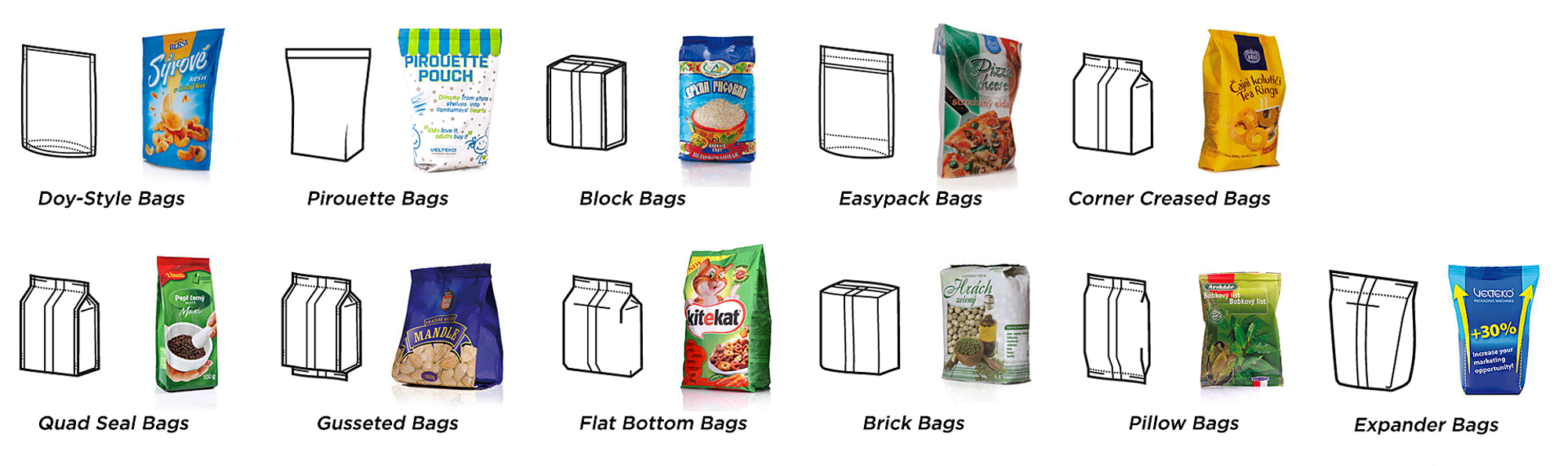
Velteko's Versatile-280 and Versatile-360 units run this way, and their Washdown-360 variant is built specifically for wet, hygiene-sensitive environments — hose it down between runs without worrying about electronics. If you're scaling toward premium export shelves, the changeover speed is the real story: a single operator can switch between 100+ bag styles — including doypacks and resealable zip pouches — in under 45 minutes, which matters when retail demand shifts faster than your production plan.
GKS's VFFS systems take a different angle: compact, modular builds that keep footprint small — a real constraint in a lot of older NZ factories where floor space wasn't designed around modern packaging lines. GKS also leads on sustainability: their LEAF system runs 100% recyclable, compostable paper mono-materials on a standard vertical line without giving up speed, which is increasingly relevant as plastic-reduction targets tighten here.
Bulk/FIBC filling is its own category entirely — 500kg to 2 tonne bags for export or bulk industrial supply, a different machine class from anything bagging retail-sized product.
Manufacturer throughput numbers are tested under ideal conditions — consistent product, trained operator, no changeovers. Real-world output usually sits 15–25% below the spec sheet once you factor in bag changes, product variation, and normal operator pace.
Size for your actual average shift, not the number on the brochure. Undersizing means bottlenecking your whole line at the bagger. Oversizing means paying for automation you don't use and, with some systems, struggling to run efficiently at low speed — a machine built for 40 bags a minute can run rough at 10.
Full automation isn't always the right call. Semi-automatic bagging — where an operator loads and positions bags while the machine handles the fill and seal — still makes sense for:
Bag Automation's BSA-HS series is a good example — semi-auto, but high-speed enough that plenty of NZ operations never feel a need to move to full automation.
This is the one we'd push hardest, because it's the one that bites people six months after the sale. New Zealand sits weeks away from most equipment manufacturers by sea freight. If a control board fails or a seal needs replacing and the nearest spare part is in Germany or Taiwan, that's not a two-day wait — it's potentially a month of downtime.
Ask any supplier, ours included, three specific things before you buy:
We carry Bag Automation, GKS, and Velteko specifically because we can back them with parts and service through our own team — not because they're the only brands worth considering, but because we can actually stand behind them once they're installed. That's worth more over five years of operation than a slightly better spec sheet.
Open-mouth systems use premade bags that are filled then sealed shut. Valve bags self-seal once filled through a valve, which is faster for high-volume bulk product but offers less control over final bag presentation.
Only if your volume justifies it. Many NZ operations run semi-automatic systems well past the point where a larger business would have moved to full automation — it comes down to volume, changeover frequency, and floor space.
Depends on the brand and whether it's built to order, but plan for several weeks to a few months for new equipment shipped from Europe or Asia. Ask your supplier for a specific lead time before you commit to a production timeline around it.
Work backwards from your current or projected shift output in units, not bags-per-minute in isolation — then add the 15–25% real-world buffer mentioned above.
Browse our current range of bagging machines from Bag Automation, GKS, and Velteko, or get in touch to talk through which system fits your line.